|
How many spaces after a period? One or two?
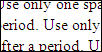
The question of how many spaces one should place after a period when typing is a question as hotly debated as whether a roll of toilet paper should unroll from the front or the back.
Let me begin by saying that my mother was a college-level typing instructor back in the day when the use of business machines was taught in community colleges to those who were destined to work in office steno and typing pools. So I grew up learning the finer skills of how to properly load a typewriter with two sheets of paper, including carbon paper if a copy was to be made, and the proper typing techniques. But, oh, how I have rebelled after all these years.
, I have seen both single and double space after the period, but for the life of me, I can't figure out if it's a matter of education, age, gender, geography or just not really caring one way or another. But it does pretty much cuts down the line. My own background was to go with the double space or suffer the wrath of my mother, but then going through journalism school in the 1970s, I was taught the single space standard. There's nothing like a journalism professor and then a hard-drinking, cigar-smoking, cursing newsroom copy editor screaming at you every time you did something wrong to get you with the program. So the single space stuck.
So enough of the personal background. So what's the (modern) reasoning for using the single space, you ask? It basically comes down to progressing from typewriter-produced monospaced font to computers, which use word processing programs that can handle and adjust the spacing between the period and the beginning of the next sentence. As for established styles, goes with the single space as a preference, but leaves the door open to say that there is nothing wrong with using two spaces after ending punctuation marks unless an instructor or editor states a preference one way or another. In this case, it's best to consider the directions of the person assigning the grade or signing the paycheck. even chimes in with a little information:
The two spaces convention was brought out by the use of monospaced font on typewriters, and carried on solely by tradition. Most fonts used in word processors since the mid-1990's have the correct spacing already adjusted, rendering the traditional double space after a full stop (period) obsolete.
And there was a discussion posted last year about the topic. Oh, as I said, everyone has an opinion, and this was no exception.
So this is where I stand. If it's a document I will be managing and someone else has created the document using two spaces, I will change it. However, if I'm that I will not manage, I won't touch the spaces and won't even mention it. And back in the day when I was grading high school papers, I focused on content, grammar and mechanics. My students really didn't need to worry about the spacing issue.
My preference? I like one space after the period sort of like the way I prefer the roll of toilet paper to unroll from the back.
# # #
Some of our more popular posts:
How to stop confusing Me and I. Me and Billy will explain it to you.
Honestly, every time I hear "I" and "me" used incorrectly, I'm afraid my head is going to explode, or at least start spinning the way Linda Blair's did in the movie, The Exorcist.
How many spaces after a period? One or two?
The question of how many spaces one should place after a period when typing is a question as hotly debated as whether a roll of toilet paper should unroll from the front or the back.
I'd Rather Cuddle Then Have Sex. Really? It's all about the grammar.
We have recently been seeing people confuse the words then and than. The word then seems to be used when the writer should use than. Of course, several sites have made fun of this word misuse.
How to Write a 500 Word Essay That Will Get You Into College
It's college application season. Or at least it is in our house. The current challenge seems to be how a student applying for college can work within the 500-word limit imposed by the Common Application and create an essay that covers a significant event or achievement in the student's life and will, hopefully, set the student apart from tens of thousands of other applicants.
Outsourcing vs. offshoring, and how U.S.-based technical writers can stay competitive
We have recently heard people confuse the distinction between "outsourcing" and "offshoring." To clarify, outsourcing is when a company hires another business, such as , to do a specific task for them either because they do not have that talent in their existing labor pool, or they need to temporarily add skilled members to their existing team, but cannot justify hiring them as permanent staff.
What Are the Characteristics of a Good Technical Writer?
In my previous post, I started to address the question, I concluded that most writers do not set out to go into this field, but more likely happen into it by chance or by a series of stepping stones that naturally led them down this path. I stated that through nature and nurture, people are formed to become a writer. So, what characteristics make up your average writer?
Where To Go To Become a Tech Writer or To Find One To Hire?
Finding a single place to learn about Technical Writing is not the easiest task. Because of this, it is even trickier to find a good source for locating potential candidates for the job. Many writers seem to be just born with this ability, while others have learned it through intensive study. Meanwhile, others have gone a path in life that through training, natural abilities and fate have gravitated to this field.
18 Web Sites and Blogs That Will Improve Your Writing Skills
Writers grow as writers if they have good resources. The following sites (in no particular order or ranking) are good writing resources that we keep going back to frequently:
1. I'd Rather Be Writing
An excellent and timely collection of articles written by Tom Johnson relating to the current trends in technical communication.
2. EServer TC Library Resources>Writing>Technical Writing>Blogs
The EServer TC Library is a free, open-access, human-edited directory of online resources for people who produce, manage, archive, and distribute technical information. The community we serve includes technical communicators (such as technical writers), editors and publishers, researchers, illustrators, animators/multimedia developers, instructional designers/educators, web designers, instructional designers, user experience designers, and others who concern themselves with how to improve human communications.
|